













 Which American 2000s TV Series Are You?
 The Perpetual Student Syndrome: When Self-Development Becomes a New Form of Procrastination
 Test: Who Were You in a Past Life?
 Your Mythological Totem: Take the Test and Find Out Which Ancient Creature Protects You?
 Adulthood Test: Find Out How Old You Really Are
 Empathy Check. How Well Developed Is Your Emotional Intelligence?

 English
 Русский
 Deutsch
 Español
How the Christmas Tree Became the Symbol of the New Year: From Pagan Groves to Sparkling Ornaments
Every December, the same guest enters our homes again and again — prickly, smelling of resin, and somehow absolutely irreplaceable.

You can argue about tangerines or about which movies deserve to be watched during the holidays, but without a Christmas tree, the celebration feels somehow unfinished. We decorate it with garlands, tinsel, and ornaments, often without even wondering: why did this particular tree become the main symbol of the winter holiday? Why not an oak or a maple?
The history of the New Year's tree is more tangled and fascinating than it seems. Behind it lie ancient pagan rituals, German reformers, an English queen, imperial decrees, and even ideologues who favored the tree for reasons that were far from accidental. Let's trace this journey - from deep forests to shining glass baubles - and figure out how it all happened.
Evergreens Against Winter: Pagan Roots
Long before Christianity, people in Europe decorated their homes with branches of evergreen plants - fir, spruce, holly, yew - during the winter solstice. In the darkest days of the year, they symbolized the triumph of life over death: when everything around appeared lifeless, the evergreens stayed green, seen as a sign of endurance and hope.
Among the ancient Romans, homes were adorned with evergreen branches during Saturnalia, while in Northern Europe similar customs were connected to the worship of nature and forest spirits. These were not "Christmas trees" in the modern sense, but rather green elements in home décor - wreaths, branches hung above doors, or little green "charms" against evil spirits and winter gloom.
Christianity did not abolish this custom but gradually reinterpreted it. Evergreens began to represent eternal life and the hope of salvation. The idea of bringing a whole tree into the home - one around which the family gathered - appeared later, in Central Europe.
The German Christmas Tree and European Fashion
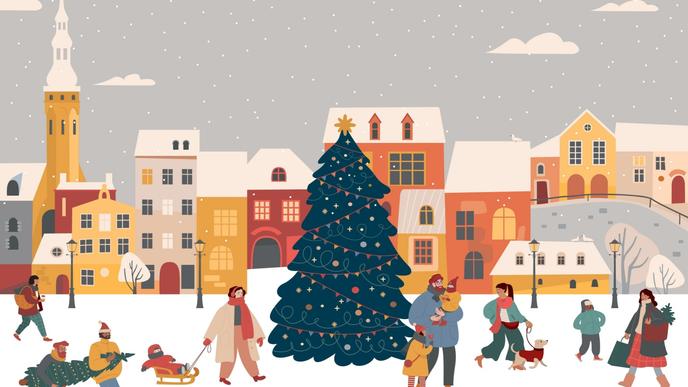
Most historians trace the origins of the modern Christmas tree to the German lands and the Baltic region. Sixteenth-century documents mention decorated trees in Strasbourg and other towns: Protestants placed them in their homes, hanging paper roses, apples, nuts, sweets, and small figurines on the branches.
According to legend, the reformer Martin Luther once walked through a winter forest, saw stars twinkling through the branches, and decided to recreate the scene at home - he set up a fir tree and lit candles on it. Historians debate the accuracy of this story, but by the 17th-18th centuries the tradition of a "Christmas tree at home" was already firmly established among German Lutherans.
By the 19th century, the tree had become a fashionable attribute of European courts. In England, it was popularized by Queen Victoria and her husband, Prince Albert of Germany: an 1848 illustration in The Illustrated London News showed the royal family standing around a decorated tree - and it sparked a craze. In France and the Nordic countries, the custom spread through aristocratic families and later through the urban bourgeoisie.
By the end of the 19th century, the Christmas tree had become a recognizable symbol of the winter holidays across Western Europe, and, through German migration, also in the United States. Nativity scenes were placed around it, gifts for children were set beneath it, and candles gradually gave way to electric lights after the invention of electricity.
Lectera’s Online Courses by topic
From Germany to the World: How the Tree Conquered the Globe
By the mid-19th century, the Christmas tree had ceased to be purely a German phenomenon. Through the spread of bourgeois culture and migration, it traveled step by step across Europe and into the New World. In England, it became truly fashionable after Queen Victoria and Prince Albert (a native of Germany) set up a fir tree in their palace and posed beside it. The illustration published in The Illustrated London News in 1848 caused a sensation - everyone wanted such a festive scene in their own homes.
In France, the Christmas tree appeared a bit later - in the 1870s, after the Franco-Prussian War, when German families from Alsace and Lorraine brought their traditions with them. Gradually, the tree became an essential part of Christmas décor even in southern France, though for a long time it was still seen as a "German fashion."
In the United States, the customs of German immigrants caught on quickly. By the mid-19th century, a Christmas tree was already decorating the White House - first set up under President Franklin Pierce, around 1856. Later, in the 20th century, the annual lighting of the National Christmas Tree in front of the White House became a national event. Thanks to Hollywood films and advertising, the tradition firmly took root throughout the country.
In Scandinavia and Finland, the custom of decorating a tree carried special meaning. There, the spruce was believed to protect the home from evil spirits and cold, while candles on its branches symbolized the return of light after long winter nights. In Denmark and Norway, by the early 20th century, numerous songs and children's poems about the Christmas tree had appeared, and it gradually became a symbol of warmth and family comfort rather than a religious ritual.
Interestingly, even in countries that celebrated the winter holidays differently - such as Japan or South Korea - the tree also found its place. By the end of the 20th century, it had become a universal emblem of the December season: set up in shopping malls, on public squares, and in homes - from Reykjavik to Rio de Janeiro. Thus, the fir tree journeyed from a rural ritual of German craftsmen to a global symbol of joy and light.
But Why the Fir Tree - and Why the Ornaments?

If we set aside ideology and politics, the choice of the evergreen tree seems quite logical. Ethnographers note that for northern peoples, a green tree in the middle of winter is a powerful image: it defies the rule of decay and reminds us that life continues. In Christian symbolism, this idea merged with the concept of eternal life and hope, and in the secular world - with the simple human feeling of comfort: the smell of resin, the soft light in the darkness, and the sense of safety around the tree.
The decorations, too, grew out of ancient symbols. Apples and nuts that once adorned German trees alluded to fertility and the Garden of Eden; sweets represented joy and abundance. Over time, these were replaced by glass baubles and figurines - more practical and durable, yet carrying the same meaning: the ornaments on the tree are signs of the good things we hope will "grow" in the coming year.
Modern psychologists add another layer: decorating the tree together is a social ritual that builds a sense of unity. Families and friends decide how it will look, argue, laugh, and finally create a shared picture of celebration. For many people, childhood memories of the holidays are not just about gifts but about that very process - opening the box of ornaments, hanging them carefully, switching on the lights, and stepping back to admire the glow.
In the end, the Christmas tree unites several layers of meaning at once: the pagan belief in the power of evergreens, the Christian symbol of hope, European domestic tradition, and the modern global culture of the winter holiday. Today, when we set up a tree in the corner of the room, we hardly think of Romans, Lutherans, or Victorian engravings. Yet all of that history still lives in the moment when the garlands light up, the scent of pine fills the air, and it suddenly becomes a little easier to believe that the new year truly can be better.
Share this with your friends via:
Latest News

Fall 2026 promises to be an eventful season for education worldwide.

Tickets for WE Convention 2026 are now available - with 25% off for EARLY BIRDS!

The private school Alpha School, which has opened campuses from New York to California, uses AI bots to teach children academic subjects for just two hours a day. The school has no traditional teachers, no homework, and tuition reaches $65,000 per year.

UK Prime Minister Keir Starmer has announced a major public-private partnership in the field of artificial intelligence. Google, Microsoft, Amazon and NVIDIA, together with the government, are launching an AI skills training programme for 7.5 million British workers.

International educational programmes provider Study Group has announced a change of ownership. The company has been acquired by Arete Education – an investment structure in the higher education sector created by Global University Systems (GUS) and US private investment firm Brightstar Capital Partners.
