













 Which American 2000s TV Series Are You?
 The Perpetual Student Syndrome: When Self-Development Becomes a New Form of Procrastination
 Test: Who Were You in a Past Life?
 Your Mythological Totem: Take the Test and Find Out Which Ancient Creature Protects You?
 Adulthood Test: Find Out How Old You Really Are
 Empathy Check. How Well Developed Is Your Emotional Intelligence?

 English
 Русский
 Deutsch
 Español
Project “Human”: How We Have Spent Centuries Trying to Become Better Versions of Ourselves
Today, self-development is practically a synonym for a “hobby.” In other words, it is as inseparable a part of everyday life as work, watching TV series, riding a bicycle in spring, or reading fiction.

Because if you are not developing yourself, you are overboard. But have you ever wondered when exactly this became not just a trend, but a norm at the level of a must-have? You think recently, right? Then you are in for a surprise!
People have been trying to surpass themselves for centuries - it is just that each century kept raising the bar higher and higher and changing the very meaning people put into the word "develop." Self-development existed in the Middle Ages and even in antiquity, but it changed dramatically from century to century. In the end, every era had its own ideal and its own rules of the game, which is why the history of self-development begins not with habit-tracking apps and psychology books, but with… Ancient Greece?!
Paideia, the Sophists, and the First Coaches
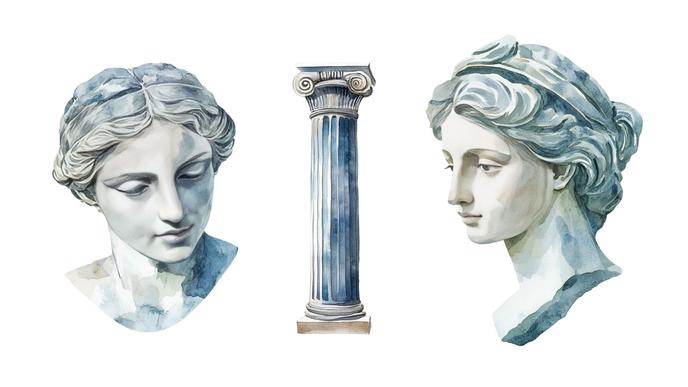
In Ancient Greece, a person devoted not their spare time to self-development, as people do today, but their whole life. It was part of the process of raising a human being and was called paideia - the shaping of a person through knowledge, exercises, habits, and participation in the life of the polis. Social expectations were incredibly high: a person had to be excellent both in body and in spirit. For an elite man, this meant a whole set of disciplines that he was expected to study and train in from the age of seven: rhetoric, philosophy, music, poetry, gymnastics, and military preparation. To develop yourself meant not to "search for yourself," but to prepare yourself for public and socio-political life, since all citizens bore responsibility for the flourishing of their city-states. Consequently, they also needed debating skills, an understanding of legal matters and governance, and, of course, incomparable oratory.
It was precisely in this era that people appeared whom we could easily call coaches today. Sophists such as Protagoras and Gorgias - famous ancient Greek thinkers and rhetoricians - traveled from city to city and, for money, taught young aristocrats how to speak in a way that would let them win arguments, persuade crowds, and successfully build political careers. This was not an "ancient university," but rather something like courses or tutoring: if you lacked charisma and persuasiveness, you went to a professional and paid for instruction. Incidentally, it was also in this period that the conflict between internal development, meaning the cultivation of spirit, and external development, meaning training in what is profitable and will eventually bring financial benefit, was born. People back then, too, often had to choose one or the other.
For women, however, this system was almost completely closed. Exceptions such as Aspasia of Miletus - an educated woman in the circle of the Athenian ruler Pericles, whom ancient authors associated with rhetorical culture and the intellectual life of Athens - only underscored the rule. A developing person in the full sense of the word was understood primarily as a free man who was meant to go out into the world and work for its good. The range of roles available to women, meanwhile, was extremely narrow - either a temple priestess or a wife - and so education for them was correspondingly limited.
The Seven Liberal Arts, Knightly Virtues, and Piety
If antiquity placed its bets on civic and intellectual life, then the Middle Ages and the so-called Christian world glorified the salvation of the soul, which meant that what one had to learn was nothing less than inner discipline and virtue. Instead of the question "How bright and persuasive are you?", which was most typical of antiquity, the Middle Ages replaced it with "How rightly are you living?" For an educated person, the foundation was the seven liberal arts: first the trivium - grammar, rhetoric, and logic - and then the quadrivium - arithmetic, geometry, music, and astronomy. This was not just a school curriculum, but the very framework of education. A person who had not passed through this base was looked down upon in intellectual circles - likely no better than impoverished peasants.
But the self-development of the Middle Ages was not limited to theory and the reading of useful books. Knights - and at the time this was a full-fledged profession - had their own required set of "upgrades": horseback riding, fencing, archery, swimming, hunting, playing chess, and sometimes even music and poetry. After all, a knight had to be not only a fighter, but also a representative of the state and the king, which meant he had to possess self-restraint, manners, uphold a code of honor, be devout, and at the same time know how to present himself properly to high society. In other words, a fine sword without a fine reputation was considered insufficiently sharp.
For women, the boundaries were much stricter. But whereas in Ancient Greece the choice was simply limited, in the Middle Ages, alongside those limitations, there were also extraordinarily high, almost unattainable "quality criteria." Thus, self-development for women passed through piety, household management, reputation, needlework, reading prayer books and moral texts - ideally, a woman was supposed to know them all by heart - and sometimes writing and literature, if her origin and circumstances allowed it. Against this backdrop, the figure of Christine de Pizan stands out especially. A French writer at the turn of the fourteenth and fifteenth centuries, she became one of the first women in Europe to live by literary work. At the beginning of the fifteenth century, she wrote The Book of the City of Ladies, and then The Book of the Three Virtues - in essence, a guide to how a woman might preserve dignity, reason, and inner strength in a world accustomed to seeing her as weak and incomplete. It was not a manifesto calling for independence, no, but de Pizan became the first woman to speak openly about the importance of women's intellect, at a time when high intelligence in a woman in the Middle Ages was seen more as a defect than an advantage.
The Universal Human Being, Manners, and the First Habit Tables
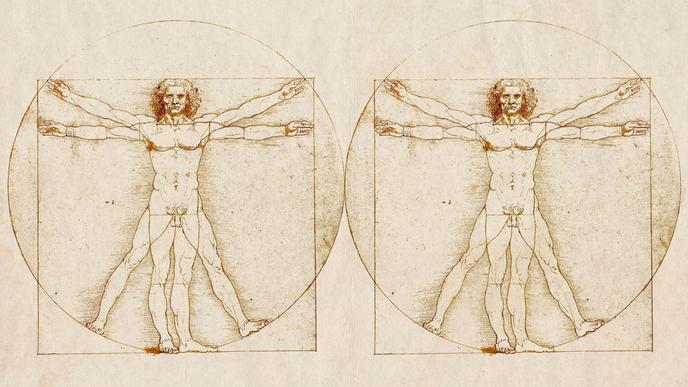
The Renaissance and the Enlightenment brought self-development closer to the form we can easily recognize today. It was precisely in this era that a person stopped being merely the bearer of a particular role and turned into a project that could be consciously worked on. The ideal of the universal person emerged - educated, curious, disciplined, capable of many things at once. The clearest symbol here is, of course, Leonardo da Vinci: at once an artist, engineer, anatomist, and researcher - a person for whom development was not one specialty, but a way of existing in the world.
At the same time, a more secular line of development also appeared - it was still important to be educated, but at the same time you could not look strained or arrogant. This was expressed very precisely by Baldassare Castiglione, the sixteenth-century Italian diplomat and writer, in The Book of the Courtier. There we encounter the concept of sprezzatura - the art of doing something difficult as though it cost you nothing. In essence, this was one of the first texts about self-presentation, whose entire meaning came down to the idea that it is not enough to be developed; it is also important not to look like a dull pedant who is trying too hard. A person whose knowledge stuck out too visibly, as in antiquity, could be considered heavy, ridiculous, or simply unpleasant. In other words, already back then self-development included not only the accumulation of skills, but also the subtlety with which they were presented. In modern terms, emotional intelligence and image.
Then, in the eighteenth century, the first "habit tables" appeared - the ancestors of modern checklists. Benjamin Franklin, the American politician, inventor, and one of the Founding Fathers of the United States, composed a list of 13 virtues. It included temperance, silence, order, resolution, frugality, sincerity, calmness, and so on. He proposed that one track in a table one's level of development in these qualities and mark one's weak spots. This approach became the symbol of a new turn: namely, a view of self-development not as continuous memorization or exploration, but as an almost engineering-style labor performed upon oneself and one's own personality.
Self-Help, Mechanics' Institutes, and Self-Made Entrepreneurs
In the nineteenth century, self-development had already acquired its modern name and began functioning as a social elevator. In 1859, Samuel Smiles, the Scottish writer and publicist, published his book Self-Help, in which he turned work on oneself into a moral program. According to Smiles, a person was supposed to cultivate character, diligence, endurance, frugality, and persistence in order to become self-made and rise to the heights of society and career not thanks to birth, but thanks to personal effort. In other words, whereas earlier development had been closely tied to virtue or general education, it now became tightly interwoven with success. A useful person, in the understanding of nineteenth-century society, was someone who learns, works, overcomes, and climbs upward from the bottom.
It was in this era that more practical forms of mass development began to appear, especially for men from the working and lower-middle classes. We are talking about the Mechanics' Institutes - adult educational institutions where people were taught applied sciences, technology, drafting, mathematics, and other skills useful for the industrial age. In other words, for the first time self-development began on a mass scale to bring not only inner satisfaction, but also very tangible money. Studying became not only noble and spiritually elevated, but also profitable.
It was also in this period that the opposite extreme appeared, in the spirit of "If you are not developing yourself, then you are worthless." A person who did not attend courses, did not read books, and did not monetize their knowledge was regarded as lazy, unambitious, and unsuccessful. Thus education ceased to be a class privilege and, having become widely accessible, at the same time turned into a kind of accessory, the absence of which provoked condescension and disgust on the face of one's conversation partner. In this sense, the nineteenth century was an unprecedented era: it truly opened a path upward for the lower classes through the development of intellect and character, but at the same time it hardened morality and created new social divisions - no longer between classes, but between those who were studying and those who were not.
From Character to Charisma: Self-Development as an Industry
If the nineteenth century glorified pragmatism and technical knowledge - which in turn also helped drive the Industrial Revolution, and vice versa - then the twentieth century once again shifted the emphasis toward the ability to please, persuade, and make an impression. The sharpest turning point here is the book by Dale Carnegie, the American writer and lecturer, How to Win Friends and Influence People, first published in 1936. Self-development began to be linked with communication, influence, likability, the art of conversation, the ability to win people over and prevail in negotiations, disputes, and conflicts through human contact. Carnegie, in essence, created a revolution in self-development by returning it to the framework of social effectiveness.
After the Second World War, the picture changed somewhat - once again. Humanistic psychology added a new emphasis: one should develop not only for the sake of career and success, but for the sake of a full, meaningful life and the good of human civilization as a whole. Abraham Maslow, the American psychologist, introduced into common use the idea of self-actualization - the striving to realize one's capacities and become the person one has the potential to be. Against this background, self-development finally turned into an industry: printed books, seminars, lectures, trainings, and advice on productivity, confidence, and leadership all began to appear in abundance.
For women, the twentieth century was especially important because it was precisely during this time that they finally gained access to the same self-development men had possessed for centuries. Several processes contributed to this at once: the struggle for women's education, the suffragist movement, changes in labor legislation, and, of course, the wars, during which women massively took over jobs previously considered male. After that, it became much harder to pretend that women's development should be limited only to refinement, domestic skills, and "proper" behavior. Virginia Woolf captured this new demand very precisely in her 1929 essay A Room of One's Own: she wrote that what a woman, just like a man, truly needs is not abstract praise, but money and a space of her own. In other words, by the twentieth century it had become clear that what prevents women from developing is not "female nature," but the lack of time, independence, education, and rights.
Lectera’s Online Courses by topic
What We Call Self-Development Today
Modern self-development did not become what it is by accident. Several major shifts influenced it all at once. First, the labor market has become much less stable: one profession for life is no longer guaranteed, which means a person must constantly keep learning, master new tools, and make sure not to fall out of their field. Second, the internet and social media have turned other people's successes, skills, and lifestyles into an endless display window for comparison. Third, the language of psychology has entered everyday life: if раньше a person was simply supposed to be disciplined and useful, now they are expected also to possess emotional maturity, resilience, self-awareness, and the ability to "figure themselves out."
That is where the current set of things we tend to count as self-development comes from. It is no longer only books, education, and career. Today, that list usually includes foreign languages, digital literacy, public speaking, financial literacy, time management, communication skills, emotional intelligence, work with habits, sports, care for mental health, therapy, broadening one's horizons, and for many people, the development of a personal brand as well. In other words, a modern person is expected not simply to know something or be able to do something, but to constantly keep themselves in an "up-to-date condition" across several different areas at once.
That is exactly why today's self-development feels so heavy and almost unbearable for many people. In the past, each era had more or less one understandable ideal: the orator, the knight, the virtuous Christian, the self-made man. Now there are too many ideals, and they fit together badly. You have to be productive, but not burned out. Ambitious, but not toxic. Confident, but reflective. Successful, but peaceful and "in touch with yourself." As a result, self-development has turned into an endless project of maintaining different sides of one's personality and satisfying the needs of the market itself. And perhaps that breadth of interpretations is its main difference from past eras. Who would have thought that freedom of choice and rapid technological progress would play such a cruel joke on the human personality?
Share this with your friends via:
Latest News

Fall 2026 promises to be an eventful season for education worldwide.

Tickets for WE Convention 2026 are now available - with 25% off for EARLY BIRDS!

The private school Alpha School, which has opened campuses from New York to California, uses AI bots to teach children academic subjects for just two hours a day. The school has no traditional teachers, no homework, and tuition reaches $65,000 per year.

UK Prime Minister Keir Starmer has announced a major public-private partnership in the field of artificial intelligence. Google, Microsoft, Amazon and NVIDIA, together with the government, are launching an AI skills training programme for 7.5 million British workers.

International educational programmes provider Study Group has announced a change of ownership. The company has been acquired by Arete Education – an investment structure in the higher education sector created by Global University Systems (GUS) and US private investment firm Brightstar Capital Partners.
